Written by Ehtesamul Hoque
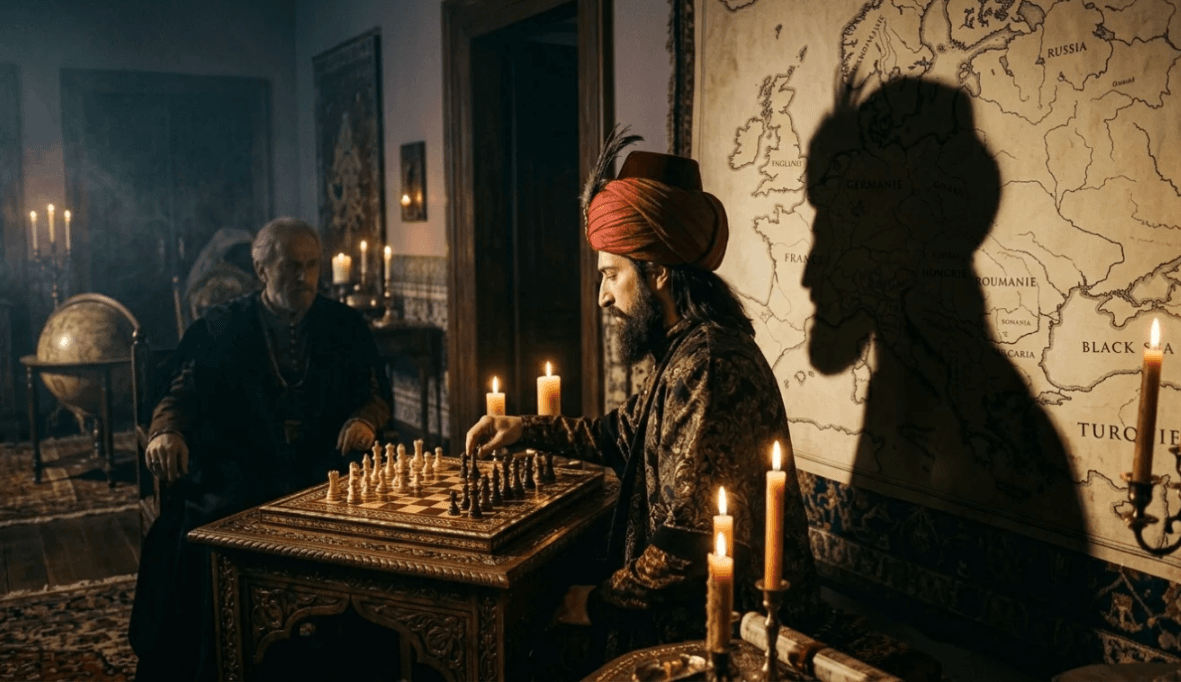
The salt-crusted air of Chittagong has always carried whispers of distant worlds. Today, it is a bustling, noisy port in South Asia, where steel ships from every corner of the globe rest in the muddy waters of the Karnaphuli River. But centuries ago, these same riverbanks were quiet cradles for the mighty wooden giants of the Ottoman Empire. To truly understand the scale of this story, one must first look at a map of the old world. Istanbul and Chittagong are separated by nearly 6,000 kilometers. This is a vast distance that spans high, snowy mountains, burning deserts, and the endless plateaus of Central Asia. In an age before planes or fast trains, this journey would take many months of dangerous travel. Yet, in the 17th century, the reach of the Ottoman Empire defied these miles, driven by a singular, burning “hunger” for development and superior technology.

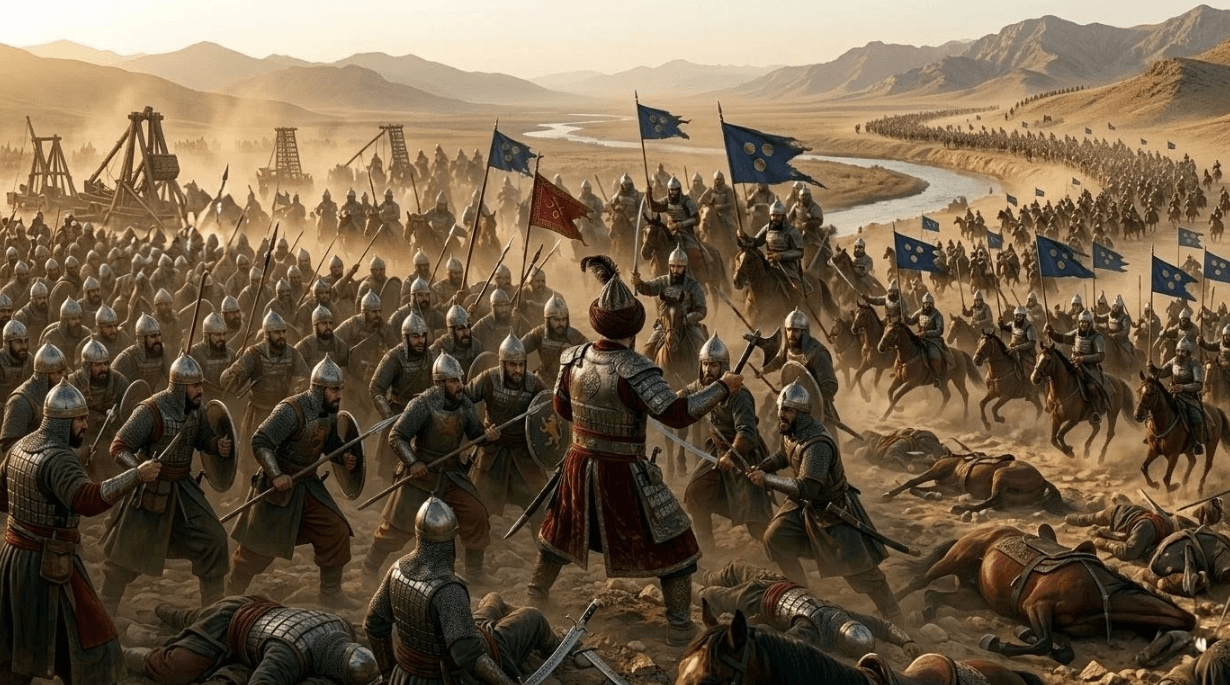
During this golden era of global history, the Ottoman Empire was navigating a world of rapid change. Under the reign of Sultans such as Mehmed IV, the Empire was not content with just ruling the Mediterranean. They looked toward the warm, tropical horizons of the Indian Ocean. The Ottomans were a superpower defined by their curiosity and their need to stay ahead of the curve. They realized that to protect the sacred trade routes and the pilgrims traveling to Mecca, they needed a navy that was stronger, faster, and more durable than anything the European colonial powers could build. This was not just about war; it was about the survival of their way of life through the mastery of engineering.
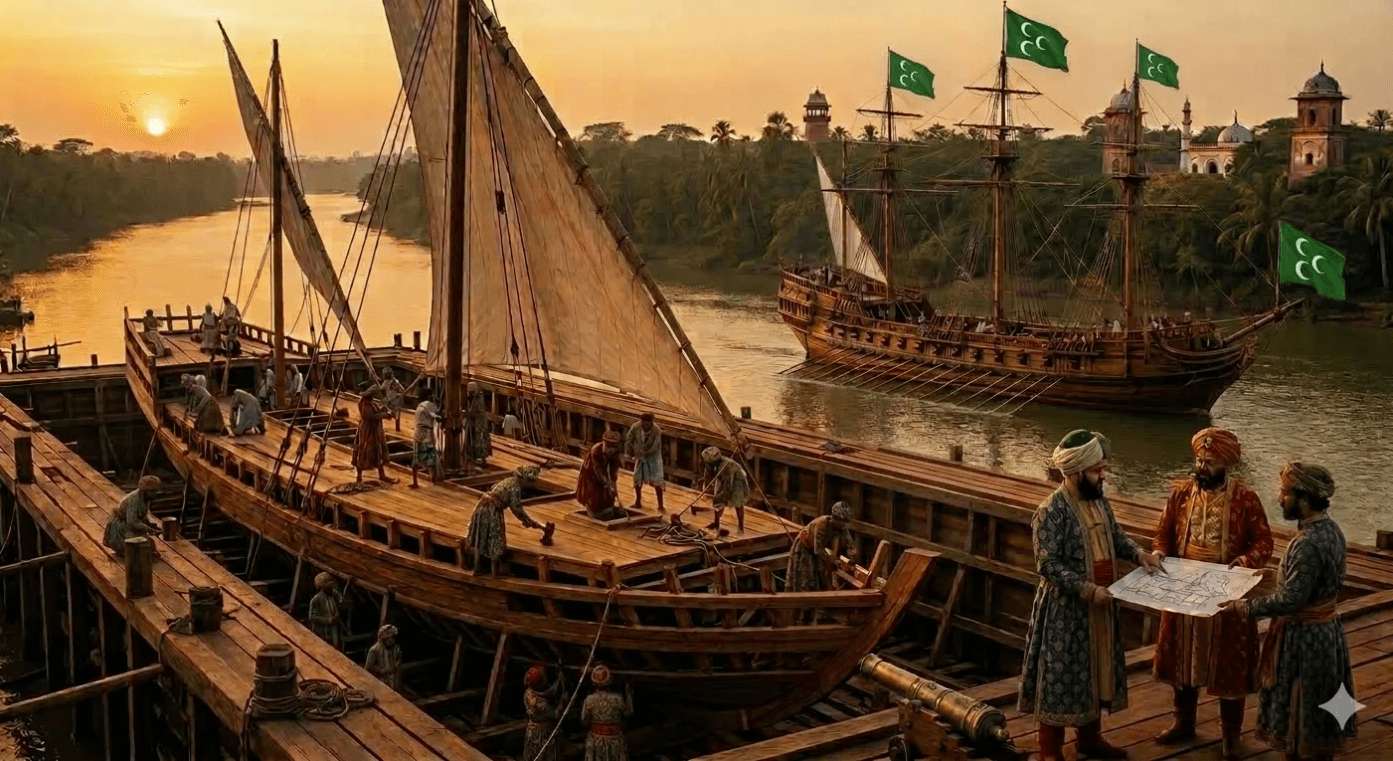
At the same time, across the vast stretch of the Asian continent, the Mughal Empire reached its greatest peak. This was the time of the powerful Emperor Aurangzeb, whose authority governed millions. In the green, rain-soaked land of Bengal, the Mughals were represented by a legendary governor, the Subahdar Shaista Khan. He was a man of vision who understood that the defense of the coast was vital. Before the great shipyards could truly flourish, Shaista Khan had to clear the Bay of Bengal of the pirates that haunted the waters. Once the coastline was secured, he opened the doors of Chittagong to the world, creating a safe harbor where the science of the Ottomans could meet the master craftsmanship of the East.
The Ottomans were led by their obsession with finding the best materials on Earth. They knew that the oak trees used by European nations were failing in the tropical heat. European galleons were often destroyed not by cannons, but by “shipworms”—tiny creatures that ate through the soft wood and sank ships from the inside. To solve this, the Ottomans traveled the 6,000 kilometers to Chittagong to find a natural defense. In the forests of Bengal, they discovered Teak and Jarul wood. Jarul was so incredibly tough that it was often called “Ironwood.” These trees were the “high-tech” materials of the 1600s. The wood was naturally oily and so dense that the shipworms could not bite into it. For a Sultan in Istanbul, a ship commissioned from Chittagong wasn’t just a simple purchase; it was a 60-year investment in naval supremacy. While a European ship might rot in a decade, a Chittagong-built Ottoman ship could patrol the seas for a lifetime.
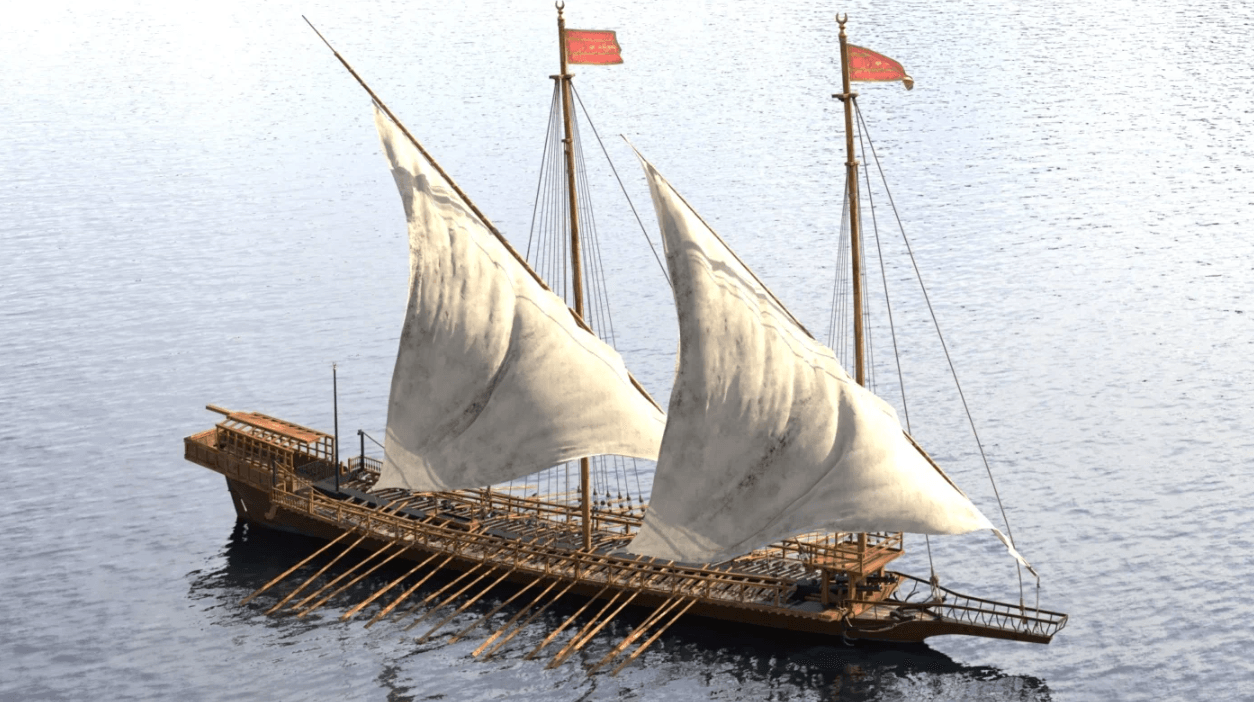
The physical shape of these ships was a beautiful marriage of two different worlds of design. The Ottomans brought the blueprints of the Kadırga, or the classic galley. To the eye, these were sleek, long, and low-profile vessels—narrow wooden arrows designed to cut through the water with terrifying speed. Because they were thin and sat low in the waves, they could be powered by dozens of long oars, allowing them to move even when the wind was dead. They also carried tall, triangular sails that could catch the slightest breeze. However, the Ottoman naval architects were wise students of the sea. They knew the Indian Ocean was much wilder and deeper than the calm Mediterranean.
To survive the giant, crashing waves of the Bay of Bengal and the fierce monsoon winds, the craftsmen in Chittagong changed the “belly” of the ship. Instead of the flat, shallow bottoms used in the West, they gave these ships a deeper, rounded hull. This curved shape acted like a heavy, invisible weight under the water, keeping the ship steady and upright when the storms raged. This made the Ottoman galleys built in Bengal some of the most stable and sea-worthy vessels in the world.
Inside these hulls, a “silent revolution” was taking place on the decks. While the Ottomans provided the military vision, the local craftsmen of Chittagong provided a specialized technology known as the “Flush-Deck.” In most European ships of that time, the decks were built in sections at different heights, which made them heavy and difficult to move across. But the Bengali design used one continuous, flat surface from the front to the back. This was a sophisticated piece of engineering that made the ships much stronger and allowed the sailors to move quickly during the heat of a battle. This flat, sturdy deck also allowed the ships to carry much heavier bronze cannons. These cannons were the “smart weapons” of the 17th century, and when mounted on a stable “Flush-Deck,” they turned the ship into a floating fortress that could hit targets with incredible accuracy.
This story is a testament to an empire that refused to be limited by geography. Every hammer-strike on the teak wood in Chittagong was a heartbeat of an empire that refused to be left behind in the race for progress. The Ottomans did not see 6,000 kilometers as a wall; they saw it as a path to innovation. They sent their best architects and master gunners across the world because they understood that development requires looking beyond your own borders. The ships launched from the Karnaphuli River were not just tools of war; they were proof that when a nation is hungry for technology, it can bridge any distance.
The alliance between the Ottomans and the Mughals in Chittagong reminds us of a time when the world was deeply interconnected by a shared love for craft and science. It was a poetic moment in history where the steel and ambition of the Mediterranean met the timber and talent of Bengal. Today, as you stand on the shores of modern Chittagong and see the giant vessels lining the horizon, you can almost hear the echoes of the Sultan’s sails. They tell us that the pursuit of knowledge is a tide that connects all shores, and that even the widest ocean is small when two great civilizations decide to build the future together.