Written by Ehtesamul Hoque
Many Muslims grow up hearing the great stories of early Islamic history. Among the most famous are the victories that happened during the life of Muhammad ﷺ and shortly after. Battles like the Battle of Badr, Battle of Uhud, and the Battle of the Khandaq are remembered as moments when a small group of believers stood against powerful enemies and survived through faith and perseverance.
It is also important to acknowledge something clearly: many of these victories were accompanied by the miracles of Allah granted to the Prophet ﷺ. At Badr, divine assistance came in extraordinary ways, strengthening the believers and striking fear into the hearts of their enemies. These miracles were real and are part of Islamic history. They were signs of Allah’s support for His Messenger and the believers who stood with him.
In these battles, the help of Allah was evident. The Qur’an itself mentions divine assistance during some of these moments. These events are not simply historical stories; they are clear reminders that faith, patience, and sincerity can overcome overwhelming odds.

During the lifetime of the Prophet ﷺ there were also other difficult confrontations, such as the Battle of Mu’tah, where a relatively small Muslim force faced the mighty Byzantine army. The courage shown by the Muslim army in that battle became legendary and demonstrated how faith could strengthen people even when the situation seemed impossible.
After the time of the Prophet ﷺ, the struggle continued under the leadership of the companions. During the caliphate of Umar ibn al-Khattab (RA), Muslim armies faced some of the greatest empires of the time. One of the most decisive moments of that period was the Battle of Yarmouk, where the Muslim army defeated a far larger Byzantine force. This victory reshaped the political map of the region and became one of the most important turning points in early Islamic history.
However, over time a certain misunderstanding sometimes develops in the minds of some people. Many think these victories happened only because those Muslims were the companions of the Prophet ﷺ.
They assume that divine help was limited to that generation alone.
According to this idea, if ordinary Muslims in later centuries faced similar challenges, they would not succeed in the same way. But Islamic history itself shows that this assumption is not correct.
One of the most powerful examples is the story of Osman I, also known as Osman Ghazi.
When Osman Ghazi appeared on the historical stage in the late 13th century, the Muslim world was not in a position of strength. The once-powerful Abbasid Caliphate had already fallen after the Mongol invasions, and Muslim lands were divided into many small states.
Earlier dynasties like the Umayyad Caliphate and the Abbasids themselves had ruled vast territories, but their rule largely continued over lands that had already been conquered during the time of the Rashidun Caliphate. In many ways, those dynasties represented changes in political leadership within an already established Islamic realm.
Osman’s situation was very different.
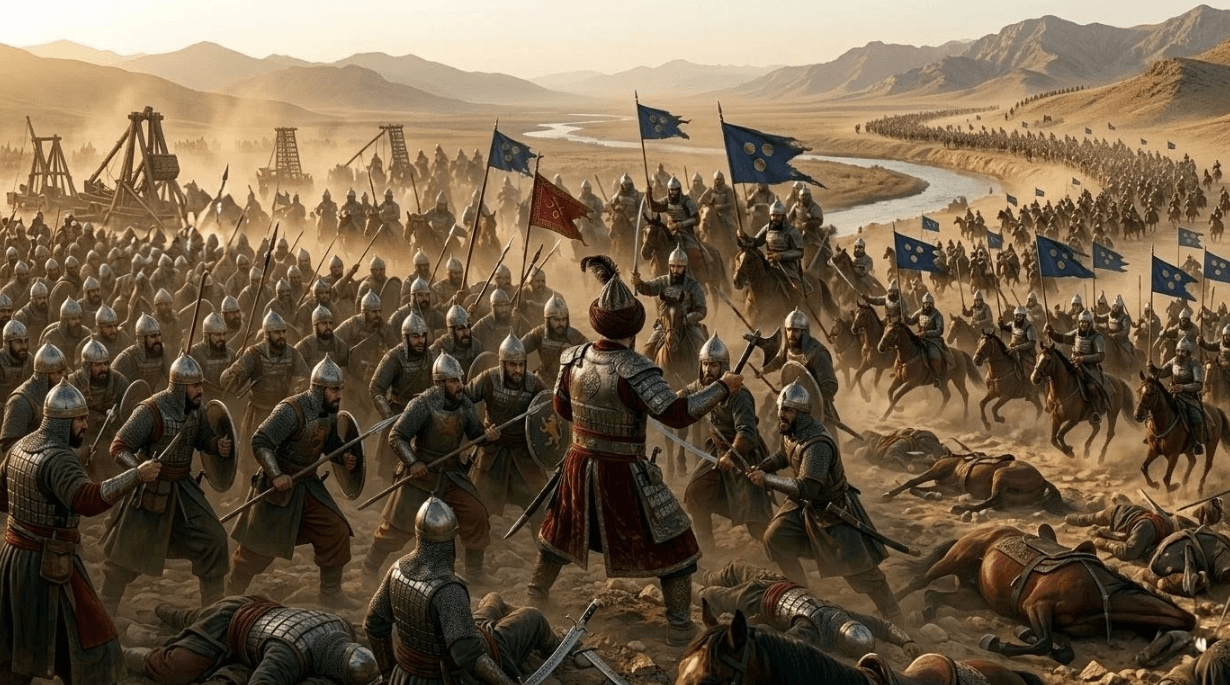
Osman himself was not the ruler of a large kingdom. He was the leader of a small frontier principality in northwestern Anatolia. His territory was small, his resources were limited, and his enemies were powerful.
To many observers at the time, it would have seemed impossible for such a small group to build anything significant.
Yet something remarkable happened.
Osman and his followers believed deeply in their mission. They saw themselves as defenders of justice and Islam on the frontier between Muslim and Byzantine lands. Their struggle was not simply about territory; it was about faith, survival, and the establishment of a just order.
From these humble beginnings, Osman Ghazi laid the foundation of what would later become the Ottoman Empire.
What makes this story so important is that it demonstrates a timeless principle: divine support is not limited to one generation.
Yes, the companions of the Prophet ﷺ were unique. Their closeness to the Prophet and their sacrifices gave them a special status in Islamic history. But the Qur’an does not say that Allah’s help is restricted only to them.
Rather, the Qur’an repeatedly emphasizes that Allah supports those who strive sincerely for justice and truth.
The rise of Osman Ghazi reflects this idea beautifully.
He did not inherit a great empire. Unlike many rulers who simply replaced one dynasty with another, Osman built something entirely new. Earlier Islamic states often emerged from existing political structures within lands that were already Muslim.
But Osman’s state was born on a frontier where Muslims were a minority and constantly under pressure.
This makes his achievement unique.
From a small tribal leadership, he created a movement that eventually grew into one of the most influential empires in world history. The Ottoman state that he founded would last for more than six centuries and shape the political, cultural, and religious landscape of large parts of the world.
His success reminds Muslims of an important lesson.
Faith is not meant to be passive. It is meant to inspire action.
The early Muslims at Badr did not simply wait for victory. They prepared, struggled, and trusted in Allah. Their faith was accompanied by effort, sacrifice, and courage.
The same can be seen in the life of Osman Ghazi. He and his followers worked tirelessly, fought difficult battles, and remained committed to their ideals even when the odds were against them.
Their story shows that history is not only shaped by great prophets or famous companions. It can also be shaped by ordinary believers who carry extraordinary faith.
For Muslims today, this message is especially meaningful.
It reminds us that the doors of divine help are never closed. What matters is sincerity, justice, and perseverance.
The victories of the early Islamic period were not miracles meant to exist only in the past. They were examples meant to inspire future generations.
Osman Ghazi’s life proves that the spirit of those early struggles did not end with the first generation of Muslims. It continued through people who believed that faith, when combined with courage and determination, could still transform the world.
In the end, the lesson is simple but powerful.
Allah’s help is not limited by time or by generation. It is connected to faith, sincerity, and the pursuit of justice.
And the story of Osman Ghazi stands as a reminder that even the smallest beginnings can grow into something that changes history.