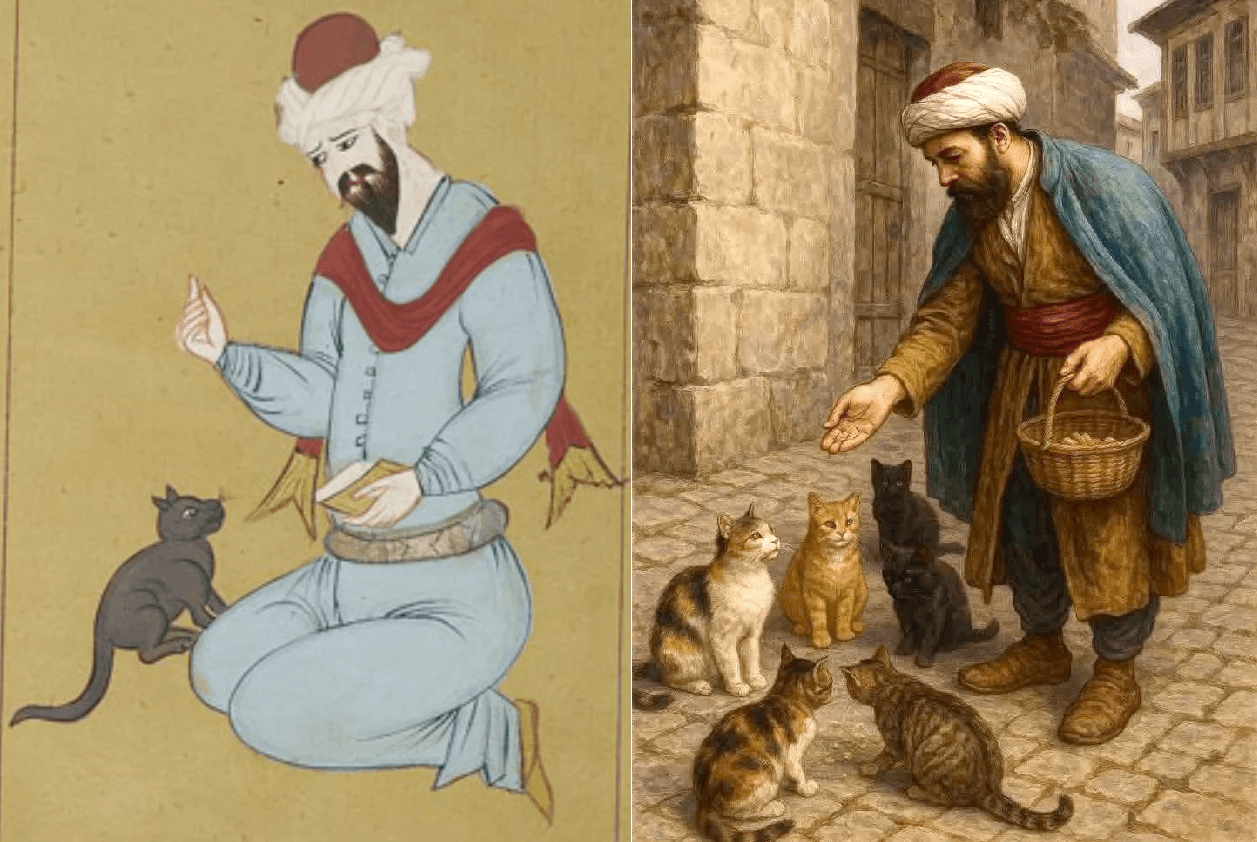
Cats held a respected place in the society of the Ottoman Empire, they were welcomed, protected, and often loved. Their presence reflected a combination of religious tradition, urban culture, and charitable practice that shaped the way Ottoman people interacted with animals.
The Ottoman attitude toward cats was deeply influenced by Islamic tradition. Stories about the Prophet Muhammad (sas) describe his kindness toward cats. One of the best known stories has the Prophet cutting the sleeve of his garment off when he heard the call to pray rather than disturbing his cat, Muezza, who had fallen asleep on it. The Prophet is said to have touched the head of another cat who saved him from a snake, which is how the cat came to have stripes on its head and how it acquired the ability to right itself when falling.

Cats were regarded as clean (ṭāhir) animals in Islamic law, meaning they could freely enter homes and even mosques. When a cat came to drink from the water the companion Abu Qatadah al‑Ansari was preparing for ablution and people reacted with concern, he explained that the Prophet had said: “It is not impure; they are among those who move around among you.” (Abu Dawud, Al‑Tirmidhi, and Al‑Nasa’i)
Abu Huraira narrated that the Prophet said: “A woman was punished in Hell because of a cat which she had confined. She neither fed it nor let it go so that it could eat the insects of the earth.” (Sahih al‑Bukhari & Sahih Muslim). The narrator himself got his name by the Prophet himself: Abu Huraira literally means “Father of the Little Cat” because he was known for caring for a small kitten and often carried the kitten with him. Feeding cats became a charitable act.
Cats played a significant role in controlling the rat population in old Anatolia, preventing damage to crops. From there came the beginning of the bond between humans and cats. Initially kept as hunters, cats adapted to urban life during the Ottoman period. Urban life, especially in Istanbul, created an environment where cats were both useful and beloved. Cats served an important practical purpose: controlling mice and rats in markets, warehouses, and homes. Especially at a time when most of the city’s buildings were made of wood, making them ideal breeding grounds for rats. Ottoman port cities stored large quantities of grain, and cats helped protect food supplies from pests.
But their role went beyond practicality. Travelers from Europe often remarked on the remarkable tolerance and affection Ottomans showed toward stray cats. Some described mosques where cats wandered freely among worshippers, occasionally curling up near pillars or lamps. These observations contrasted sharply with attitudes in parts of Europe at the time, where stray cats were often viewed as carrying demonic spirits or at least as nuisances. And cats contributed to a lower incidence of the plague in Turkey compared to Europe.
In many neighborhoods people routinely left food outside for them. Butchers were even contracted to feed street animals with leftover meat, for which they were compensated. By the 18th and 19th centuries, Istanbul had gained a reputation among foreign visitors as a “city of cats”. Streets, markets, mosques, and gardens were full of them, and residents considered feeding them an ordinary act of charity.
One of the most unique features of Ottoman society was the waqf, a charitable endowment used to fund public services. Some waqfs were specifically established to care for animals, including cats. Foundations provided food for stray animals in mosque courtyards, paid workers (“mancacı”) to distribute scraps to cats in public squares and maintained shelters where animals could rest. There were cat hospitals, one in Üsküdar and one at Dolmabahçe.
It was common for cats to sleep in mosque courtyards or inside prayer halls, especially during winter. Worshippers often shared food with them after prayers. Some mosques even developed resident cat populations that became familiar to regular visitors.
Some cats were specially trained as acrobats to entertain people, especially children. For example, during the lavish circumcision ceremony of Prince Mehmet, son of Murad III, an acrobatic cat performed for over 80 days. The cat’s ability to balance on a tightrope and perform intricate dances captivated both the prince and the audience.
Cats were also present in the Ottoman court. Topkapı Palace contained extensive gardens, kitchens, and storerooms – all places where cats were useful for controlling rodents. Palace staff reportedly tolerated and even cared for cats living within the complex.
The palace kitchens were particularly attractive environments for them. With large quantities of food being prepared daily, cats naturally gathered nearby and were often fed scraps by cooks and servants. Cats also roamed the palace gardens and courtyards, becoming part of everyday palace life.
The imperial harem (the private residential area of the palace) housed hundreds of women, servants, and children, and its residents lived in a relatively enclosed environment. Cats were often kept for companionship, as they required little maintenance, helped control mice in the building and provided emotional comfort. The sultans had some of their provincial governors send them Van cats and other types from Ankara that were not found in Istanbul.
One ruler often associated with kindness toward animals was Sultan Abdulhamid II (reigned 1876–1909). During his reign, the Ottoman state established animal protection initiatives and veterinary institutions. He was keeping nearly 1,500 cats at Yıldız Palace. In the biography of Sultan Abdulhamid, written by his daughter Ayşe, there are several mentions of the royal cat, “Agha Effendi.” Aisha wrote that her father’s bond with Agha Effendi, a white Angora cat, was so strong that even when he played dominoes with his daughter, the cat would sit contentedly in his lap. Ayşe wrote about this, saying, “Not only would Agha Effendi sit on his lap, but if he wanted, he could even lie down in the middle of our game, right on top of the dominoes, and no one had the right to protest.”
It has been reported in various sources that Agha Effendi was so spoiled that he wouldn’t eat unless his food was served to him with a fork. Sultan Abdulhamid also maintained a notable collection of Van cats and cared for hundreds of animals during his exile at Beylerbeyi Palace, where he spent significant time with his pets.
In agricultural communities cats were valued primarily for their practical role in protecting grain stores from mice, keeping barns and stables free of rodents and guarding food supplies. Farm families often tolerated or encouraged cats around their homes for these reasons. Unlike urban cats, which often lived semi-independent lives in public spaces, rural cats were more likely to be attached to specific households.
Modern Istanbul still reflects this history. Cats remain a visible part of daily life, and residents continue the tradition of feeding and caring for them in public spaces. In many ways, today’s famous “cats of Istanbul” are the descendants – both culturally and sometimes literally – of the cats that lived among Ottoman citizens centuries ago. Their enduring presence is a vivid reminder of a society that integrated compassion toward animals into everyday life.
More about Sultan Abdulhamid and his cats: https://islamicbridge.com/2021/10/sultan-abdul-hamid-ii-and-his-1500-cats/