In 1520, the 20-year-old Habsburg Charles V became Holy Roman Emperor, and the 26-year-old Suleiman I became Ottoman Sultan. Charles – ruling over the Roman-German Empire, Burgundy, the Netherlands, Italy and Spain with its American colonies – ceded the Austrian hereditary lands to his brother Ferdinand as early as 1521/22.

Until then, there had been no direct confrontation between the Ottomans and Habsburgs. The Kingdom of Hungary lay between the two great powers. When King Vladislaus II of Bohemia and Hungary died in 1516, his son Lajos was just 10 years old. He was married to the sister of Charles and Ferdinand. A power struggle erupted between the Hungarian nobles John Zápolya and Stephen Báthory over the reins of government. These power struggles paralyzed the country. When, after Sultan Suleiman’s accession, the Turkish ambassador Behram Çavuş was murdered and the annual taxes were withheld, this led to a Ottoman campaign against Hungary, in which the large fortress of Belgrade was captured in 1521. In 1522, Lajos was declared of age and crowned king. Lajos unsuccessfully appealed to his wife’s brothers for military support.
Thus, in 1526, he led a poorly equipped Hungarian army against a vastly superior Ottoman force at the Battle of Mohács and was completely annihilated. Lajos himself drowned while fleeing.
Following the mutual inheritance treaties, the royal title passed to his brother-in-law Ferdinand (who was also married to Lajos’s sister), against which a faction of the Hungarian nobles protested and they elected John Zápolya as king. In the ensuing conflicts, Ferdinand initially prevailed. Both sides vied for the favor of Sultan Suleiman. On May 10, 1529, the Sultan marched into Hungary with an army and established his camp near Mohács on August 18. John Zápolya arrived at the Sultan’s camp and kissed his hand as a sign of vassalage. The Sultan captured Buda on September 8 and installed John as king. Hungary thus became a de facto Ottoman vassal state.
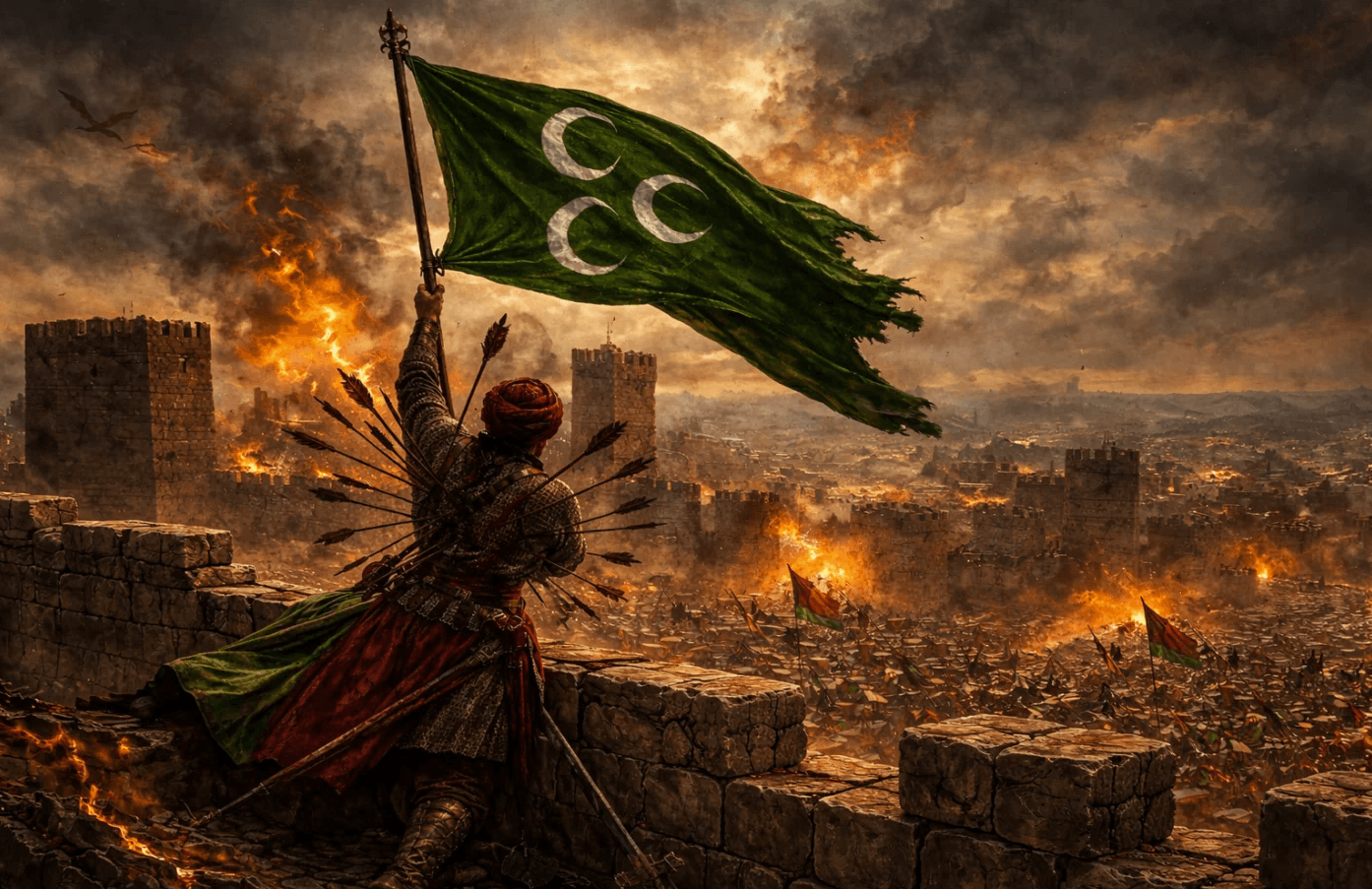
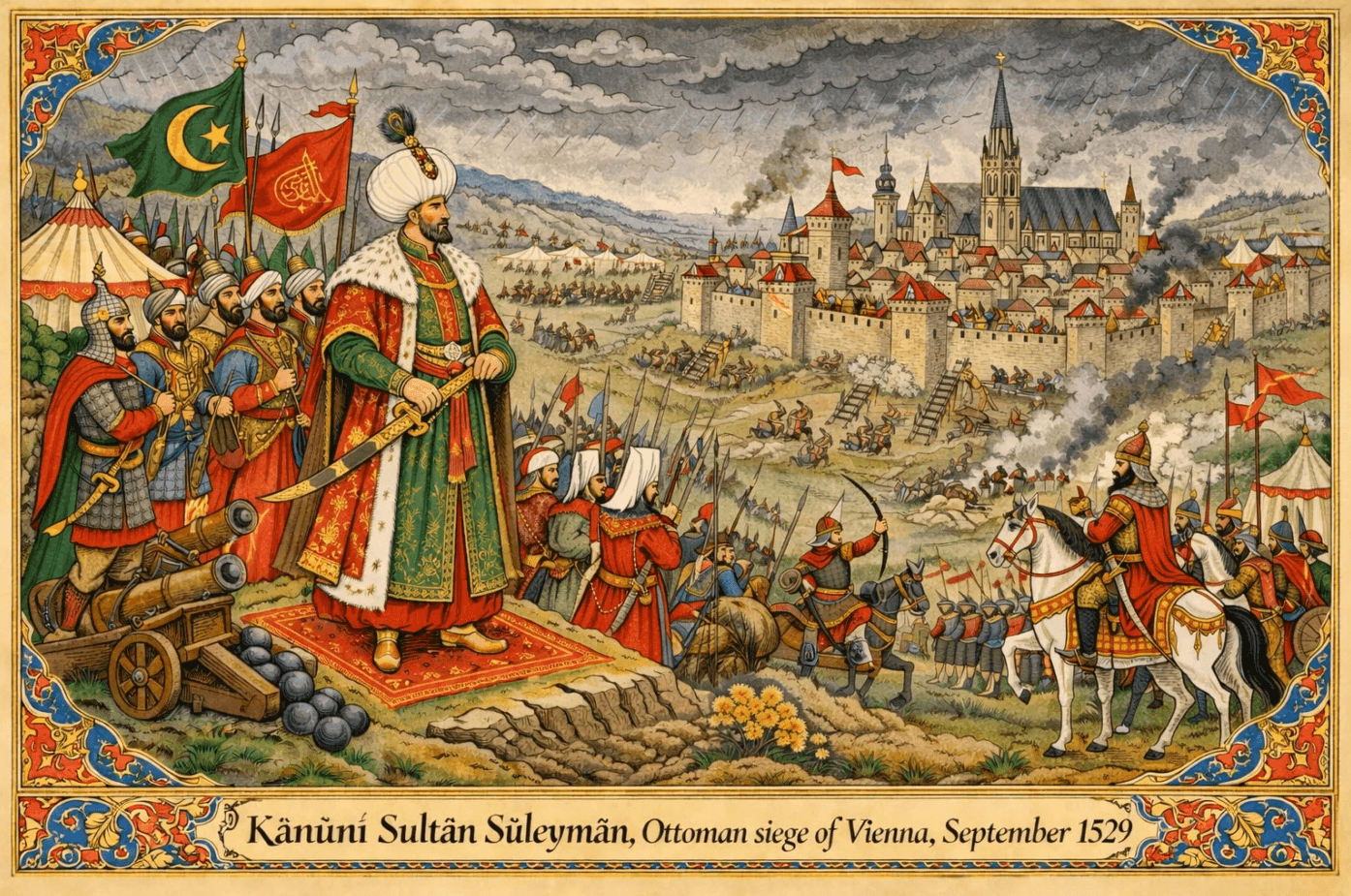
Following this success, the Sultan led his army further northwest, advancing to Vienna, which the Ottoman troops reached on September 27. Whether the goal was actually the conquest of the “Golden Apple,” as the Ottomans called Vienna at the time, or merely a demonstration of strength with which Suleimani wanted to secure his power over Hungary, is unclear. In those days, wars were only fought in the summer. Due to the late season and heavy rainfall, the Ottomans had to leave heavy artillery behind in Hungary. The roads were too muddy to transport them.
Emperor Charles V was at war with France, and the majority of his available troops were tied down there. Therefore, his brother Archduke Ferdinand attempted to make peace offers to the Ottomans and promised regular gifts. Many Viennese citizens fled the advancing Ottomans, including a large part of the armed militia. Only about 20,000 men were available to defend the city, and Vienna’s city walls were outdated. The attackers numbered approximately 100,000 soldiers. On September 27, the Sultan offered to spare the city and its inhabitants in the event of surrender. This offer was rejected. The Ottomans besieged Vienna for eighteen days, then withdrew. The troops left behind everything that hindered their retreat. It was already too late in the year, and supplies and provisions were extremely difficult due to the weather.
Three years later, the Sultan again marched towards Vienna. This time, however, the imperial army under Emperor Charles V took up positions outside Vienna, and the Ottomans turned back without a major battle taking place. In 1533, both sides concluded a peace treaty that divided Hungary: The Habsburgs retained what was known as Royal Hungary, while the rest had to be ceded to the Ottoman Empire. Ferdinand was required to pay an annual tribute of 30,000 gold florins to the Ottoman Empire.
With this Sultan Suleiman had established himself as the most powerful ruler of his time, European countries were under his rule or at least paid tribute to him for not getting conquered. His conquests were secured for long time. Given the distances and logistical limitations, Austria and the neighboring territories were simply too far away from the Ottoman heartlands to be kept under Ottoman administration, especially as the Ottoman armies returned to winter quarters in or near Constantinople every year once autumn arrived. Furthermore, there are sources saying that the Sultan learned in Vienna about a prophecy that foretold that Vienna would come to Islam peacefully in the future, therefore the city would not have to be conquered by force.
The Ottoman traveler Evliya Çelebi wrote that Sultan Suleiman had large border posts built along the Raab River (which formed the border between Austria and Hungary) and cursed its crossing: “Whoever among my warriors, viziers, and venerable descendants crosses this border to enter the land of the Giaurs shall have no luck and suffer defeat!”
In the following years, battles with alternating victors, truces, and periods of peace alternated, but in fact, no Ottoman army that had crossed the Raab to the north-west was ever victorious in a major battle.
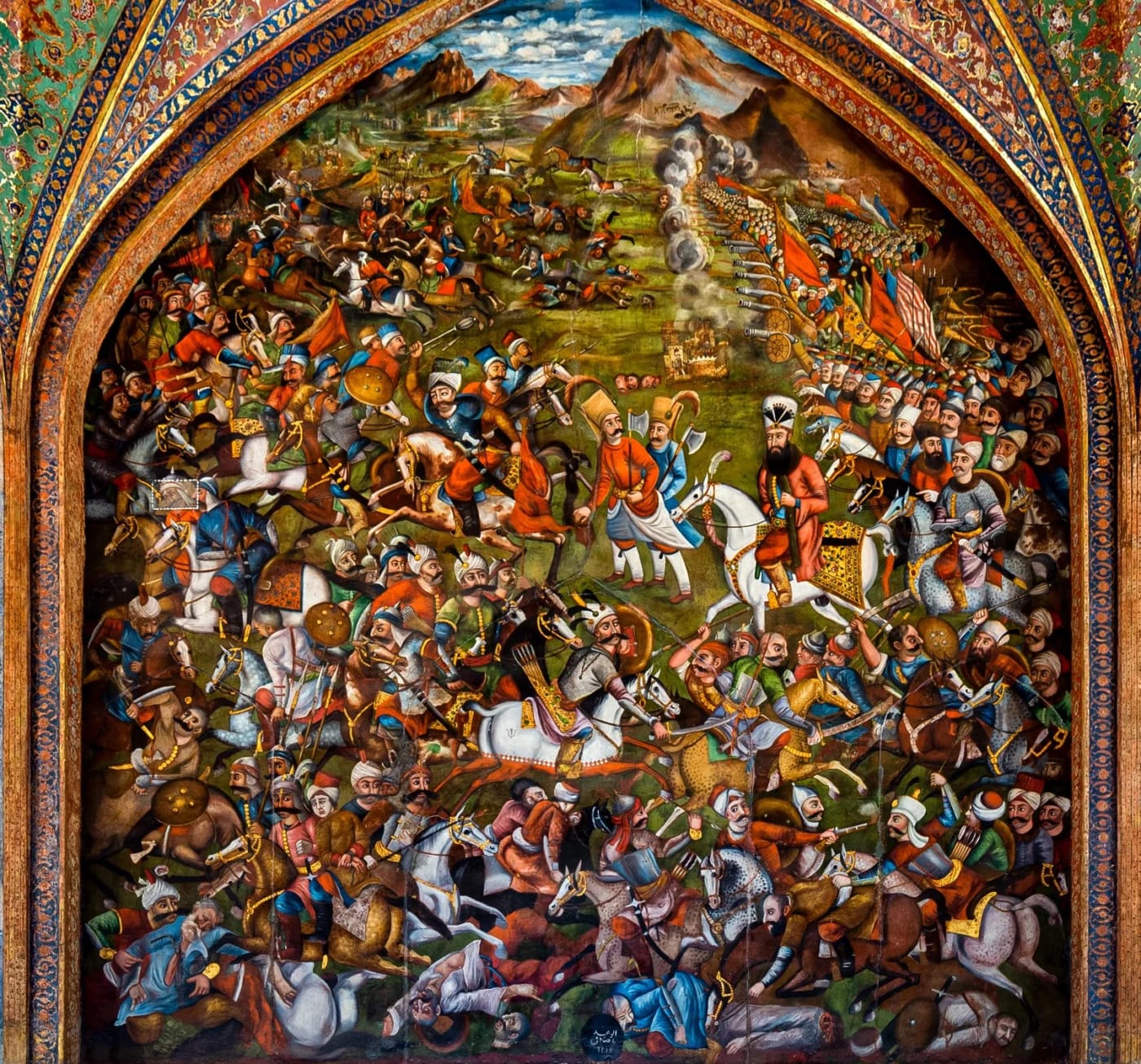
In 1606, Sultan Ahmed I recognized the Habsburg Emperor as an equal negotiating partner in the Peace of Zsitvatorok (before that, the Sultan was accorded a higher rank than all European rulers), and a one-time payment of 200,000 guilders ended the annual tribute. This peace lasted almost 60 years, allowing both sides to secure their rear while fighting other enemies: The Habsburgs were embroiled in the Thirty Years’ War, while the Ottomans were at war with the Persian Empire, among others. After tensions in Transylvania and some battles, a peace treaty was then concluded in 1664 for 20 years.
Negotiations for an extension of the peace failed in 1682. Emperor Leopold I subsequently appointed the fortress architect Georg Rimpler, who further expanded and improved the Vienna fortifications, which had already been adapted to the current military-technical standards since the first siege.
The “kuruc” uprisings against the Habsburg rule in Upper Hungary had intensified and the incursions of Habsburg forces into central Hungary provided the crucial argument of Grand Vizier Kara Mustafa Pasha in convincing Sultan Mehmed IV and his Divan to allow the mobilization of the Ottoman army. Mehmed IV authorized Mustafa Pasha to operate as far as Győr and Komárom Castles and to besiege them. In coordination with France under Louis XIV, the Ottoman army began an advance and reached Belgrade on May 3, 1683. In Fehérvár in central Hungary, the Grand Vizier announced that the goal of the campaign would be Vienna.
Kara Mustafa was the son of a Sipahi (horse-soldier) and had risen through the ranks thanks to the support of his patron Grand Vizier Köprülü Mehmed Pascha, whose daughter he married. Köprülü Mehmed Pascha and his son and successor Köprülü Fâzıl Ahmed Pascha have gained a lot of political success and fame, and Kara Mustafa was looking for an opportunity to achieve fame and glory himself. What could be more glorious than the conquest of the Golden Apple?
Emperor Leopold I and the imperial family fled from Vienna to Passau—a political necessity to organize the relief army. With him, about 80,000 inhabitants also left the city. On the orders of Count Starhemberg, who assumed military command in Vienna, the suburbs were set ablaze. On July 14, the Ottomans reached Vienna and besieged it from the south, west, and north. On July 15, the Ottomans demanded that Count Starhemberg surrender the city. When he refused, the siege began. Kara Mustafa had trenches dug, which allowed the Turks to cross the glacis under cover. The Turkish artillery fired incessantly, and the 310 Viennese cannons returned fire, while mines exploded on the castle walls.
Vienna was suffering from food shortages and dysentery. The exhausted population hoped for the imminent arrival of the promised relief army from Poland. Kara Mustafa received orders from the Sultan to lift the siege, but he intensified his efforts to conquer Vienna, thinking “a victorious general is more easily forgiven than an unsuccessful one”.
The liberation army under the Polish King John Sobieski and Duke Charles of Lorraine approached via the northern Vienna Woods and reached the Kahlenberg on September 12. After the main body of the Ottoman forces was defeated, the Ottoman army fled. They regrouped near Győr and withdrew to Belgrade, where Kara Mustafa was strangled on December 25 on the Sultan’s orders. The curse of Sultan Suleiman proved fatal for the ambitious vizier.
While pursuing the Ottoman troops, Gran was recaptured by the Habsburg troops, and Buda was recaptured in 1686. In 1686, Russia joined the war against the Ottoman Empire. Further Austrian victories followed. In the Peace of Karlowitz in 1699, the Ottoman Empire had to accept extensive territorial cessions: Hungary, Transylvania, and Bačka went to Austria, Podolia to Poland, Azov to Russia, and the Peloponnese to Venice.