Written by Ehtesamul Hoque
There is a moment in the heart of Ramadan, often hidden among its final ten odd nights, that shifts the universe. It is Laylat al-Qadr, the “Night of Power,” a night described by the Quran as “better than a thousand months.” While it is celebrated globally by Muslims, history perhaps knows no more spectacular, public, and poetic intersection of this sacred night with statehood than in the Ottoman Empire.

For centuries, Ottoman Istanbul became, quite literally, a city of light on this night. The Ottomans didn’t just mark Laylat al-Qadr; they orchestrated an ethereal spectacle that blended deep spiritual devotion with the grandeur of an imperial state.
This wasn’t merely a religious calendar date; it was the “crown” of Ramadan, a divine invitation that the empire accepted with unparalleled elegance.
The Liturgy of Light: Mahya and the City Skyline
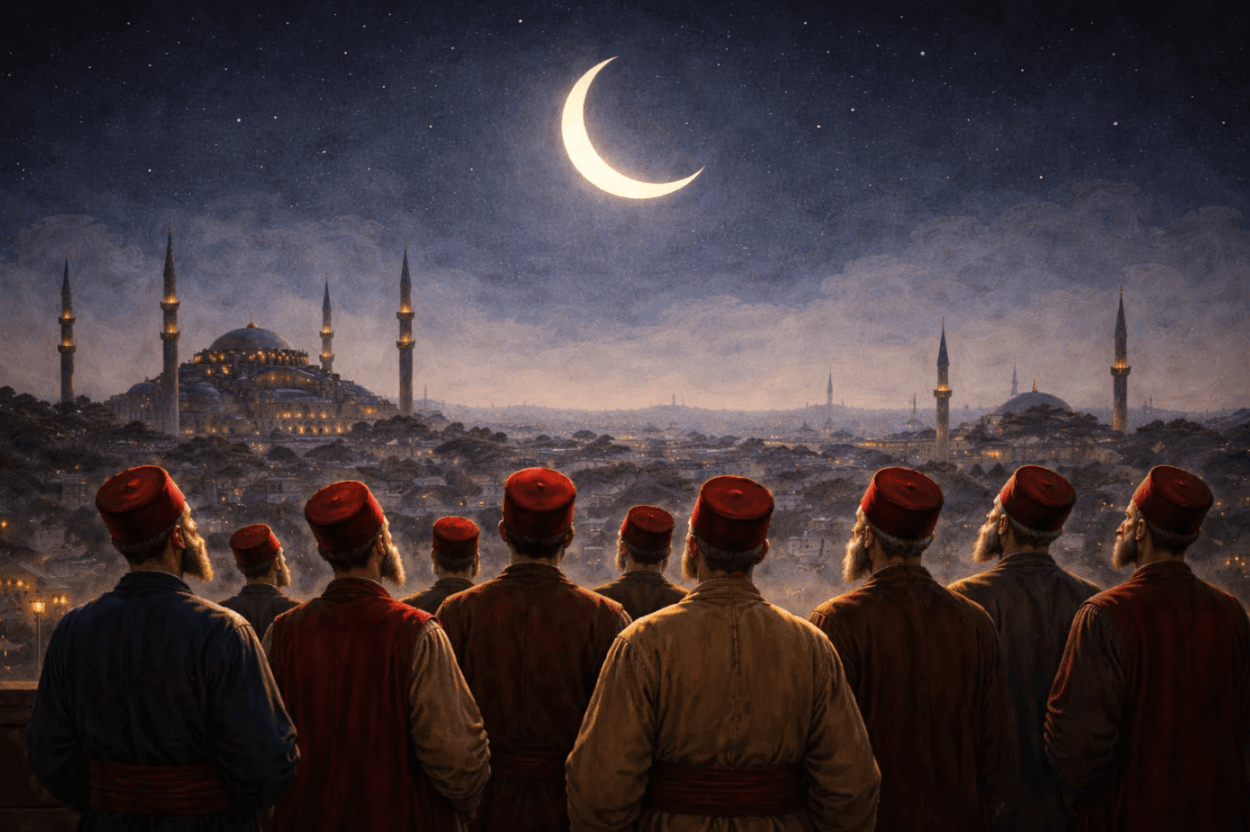
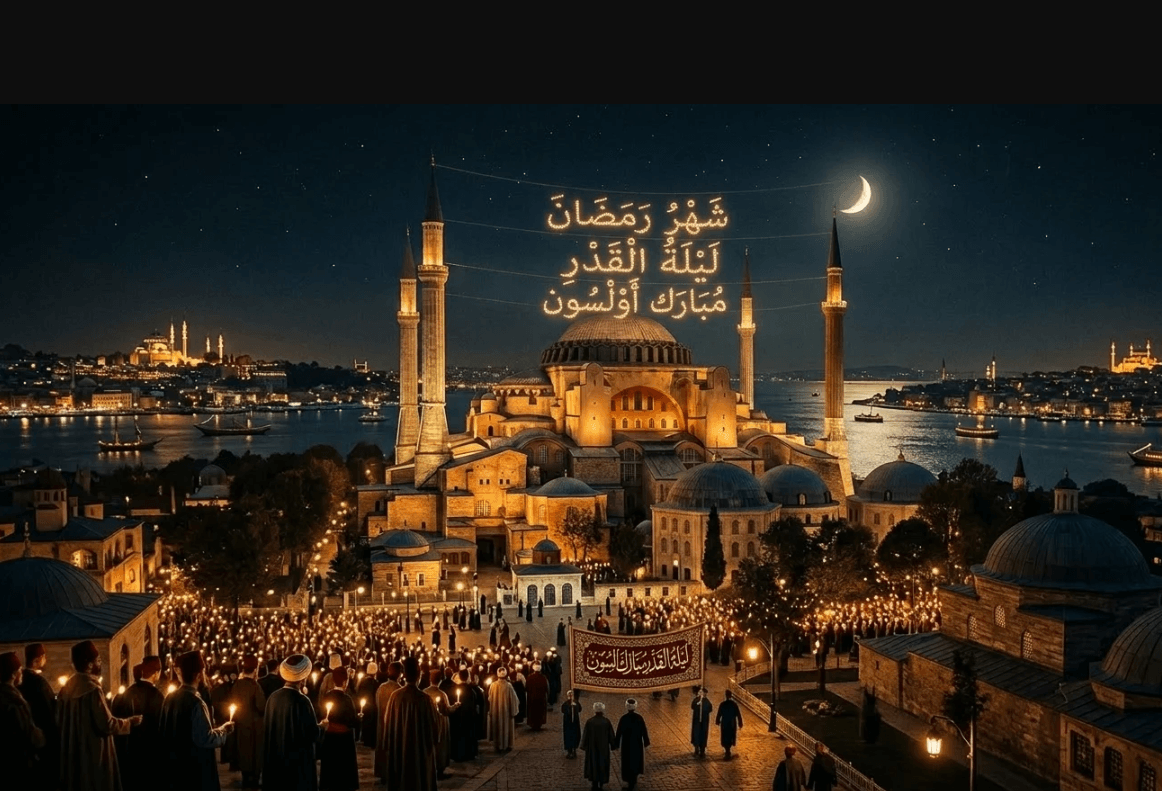
To understand Laylat al-Qadr in the Ottoman context, one must first look up. The Ottomans mastered a unique art form called Mahya—the practice of stringing oil lamps between the towering minarets of the great imperial mosques. It was on this specific night that Mahya reached its apogee.
As dusk settled, Istanbul’s legendary skyline, already punctuated by the domes of Hagia Sophia, the Blue Mosque, and Süleymaniye, would ignite. Between the minarets, words would form, traced in glowing amber: Bismillah (In the name of God), Ya Allah (Oh God), or phrases of praise for the Prophet. On Laylat al-Qadr, these were not static signs; they were glowing prayers suspended between earth and sky, guiding the eyes and hearts of the faithful toward the divine. Worshippers moving through the streets were embraced by this “sea of light,” creating an environment where the spiritual and the physical seamlessly merged.
The Kadir Alayı
The spiritual pulse of the empire beaten most visibly in the Kadir Alayı (The Kadir Procession). For the Ottomans, state and faith were intertwined, and Laylat al-Qadr was a moment where the Sultan—the “Caliph” and “Shadow of God on Earth”—publicly bowed before the divine.
This grand procession began after iftar (the meal breaking the fast). The Sultan would leave the imperial Topkapı Palace or, in later years, Dolmabahçe, to travel to one of the great mosques for the special prayers. This was no private commute. The Sultan, mounted on his finest horse, was flanked by high-ranking pashas, generals, religious scholars, and guards. Janissary corps, carrying enormous lanterns, would illuminate the path.
The streets of Istanbul, usually quiet by night, would be packed with citizens. Christians, Jews, and foreign dignitaries would watch from windows as the procession moved through the city. They were witnessing the spiritual center of gravity of the state. For the Sultan, this was not just a parade; it was an act of humility, a state official participating in the communal humility that Laylat al-Qadr demands. His presence in the public prayer hall was a symbolic declaration that before God, even the Emperor is but a humble servant.
The final destination of the Kadir Alayı—often the majestic Hagia Sophia—was the absolute emotional core of the night. For centuries, this massive cathedral-turned-mosque, with its impossibly vast dome, served as the primary gathering point.
Imagine entering: the space is not illuminated by modern bulbs, but by thousands of traditional oil lamps suspended by long chains from the highest arches. Worshippers would describe the effect as entering an inverted sky. Smoke from the lamps would drift and catch the light, turning the entire vast dome into a living, shimmering, warm golden cloud.
Beneath this sacred cloud, thousands of men, from pashas to shoemakers, would stand shoulder to shoulder, prostrating in unison, reciting the same ancient verses. The sound of their collective prayer, echoing off the ancient marble walls, was less like spoken word and more like a profound, continuous vibration. The energy in the air was described by historical observers as almost tangible. This was a symphony of devotion, a shared, powerful plea for mercy, peace, and spiritual renewal that transcended rank and social division.
The Ottoman approach to Laylat al-Qadr reminds us of something profound: that faith, when shared so deeply and publicly, can illuminate a society’s entire landscape. It transformed Istanbul from a mere political capital into a unified sanctuary of light and reflection.
Though the empire has long since passed, the essence of that night remains. The Ottomans taught us that we can honor the sacred not just with quiet, private prayers, but also by building communities that actively make room for grace, light, and a collective bowing before that which is greater than all of us. On Laylat al-Qadr, for one spectacular night, the Ottoman Empire didn’t just look for power—it lived in its light.